Founder's Perspectives

Founder's Perspectives

At Reliance’s shareholder meeting, he said succession had entered its final phase. Akash was named to telecom. Isha Ambani to retail. Anant to the group’s newer energy businesses. Three names, three arenas, with one father standing beside all three on the same stage.
Most of what followed treated this as a family that had solved its hardest problem. That is only half true, and the missing half deserves closer attention.
Assigning each child a business ends the comparison between them. It does not create a way to decide the things that still belong to all three.
Every family with more than one capable child and one company eventually meets the same arithmetic: several people, one chair, and years of comparison building toward a single afternoon when a board decides who sits in it. That afternoon is corrosive long before it arrives. Siblings start reading every promotion, every client meeting, every quarter’s numbers as evidence in a case that has not yet been argued. Reliance appears to have removed that afternoon from the calendar. Instead of one door, there are three, and each child is walking into a room already built around what they do well. Comparison has less to feed on when nobody is applying for the same job.
That is real progress, and it deserves to be named as progress. But the announcement was read as an ending, and the assumption underneath that reading is the actual problem. Role clarity is not the same as coordination.

There is a quieter reason behind the shape of the announcement too, and it has less to do with capability than with psychology. A single successor turns a family into a small tournament, three people competing for a parent’s confidence long after they stopped needing it. Distributing responsibility ends the tournament without ending the family. It reads less like a verdict on who is fit to lead the whole, and more like an attempt to keep three people bound to one shared project instead of three separate ambitions.
Three doors leading into three rooms of the same house still share a roof. Reliance remains one company, one balance sheet, one brand, one set of shareholders. Somebody still has to decide what happens when telecom needs less capital in a given year and energy needs more. Somebody has to decide, too, what happens when a decision made well inside one vertical creates a problem for the group’s name, which none of the three verticals owns alone. A large acquisition, a debt call, a listing decision: these are the moments when three separate mandates have to become one voice again. No announcement has said what that voice sounds like, or whose voice it becomes when three people who each run something real disagree.

This is the part of every family business restructuring that never makes the news, because it is not a decision. It is a method for making decisions, and methods do not photograph well on a stage.
In the families we have worked with, this is usually the meeting nobody schedules until it becomes unavoidable. Two verticals want the same capital in the same quarter. One sibling believes a decision inside their own territory should not need agreement from siblings who understand that business less well than they do. A shared brand absorbs damage from a call made in one room that nobody in the other two rooms saw coming. I have advised families who built careful structures, clear territories, clean reporting lines, defined roles on paper, and discovered, at the first decision that touched all three, that nobody had agreed in advance who breaks a tie. That gap stays invisible until the day it is tested. By then it is usually urgent, not theoretical.
The families that manage this well are rarely the ones with the cleanest chart on the wall. They are the ones who wrote down, long before it was needed, how the decisions that belong to everyone will actually be made: who sits in the room, what needs full agreement and what does not, and what one sibling’s opinion is worth when the matter touches their brother’s or sister’s territory instead of their own. Reliance may already have exactly this, written and settled years ago, far from any stage. Groups at this scale usually do. But the public conversation skipped past it, because a chart is easy to read. A decision method is not.
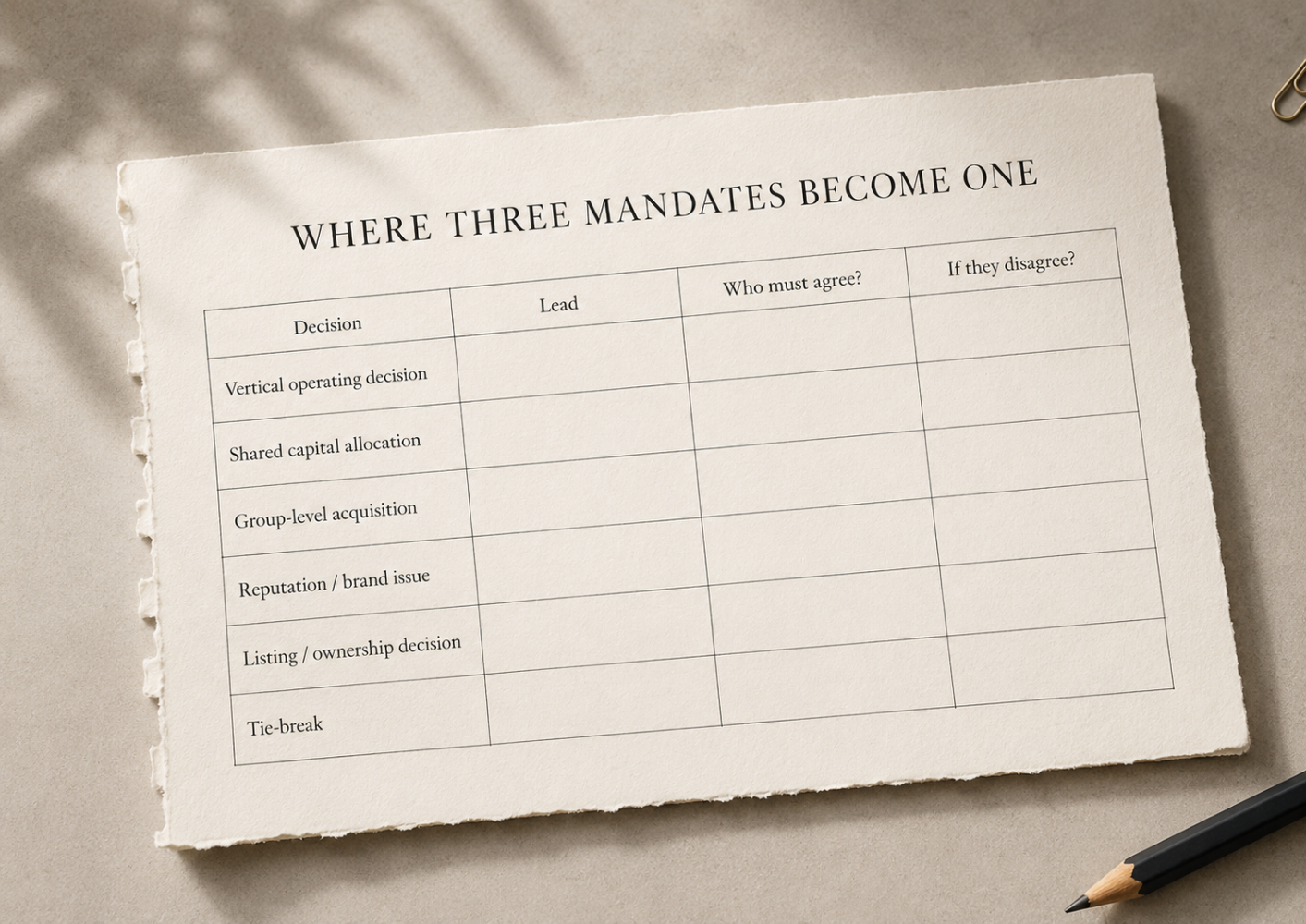
For any family watching this from outside, and recognising their own three children in it: the announcement is worth studying for what it did. It is not worth copying for what it appears to have solved.
Dividing the business among three children was the visible decision. The harder one, deciding what happens where their three worlds still meet, was never going to be announced. It has to be built, and it has to be tested, long before anyone is watching.

Every decision begins with a belief. We invest because we believe in an opportunity. We build businesses because we believe something can be done better. We prepare the next generation because we believe a legacy can evolve and endure. Those beliefs influence what we do. Our actions then change the circumstances in which we and […]
For a child who cannot hear, the challenge can extend far beyond hearing itself. It can affect how a child communicates, learns, participates in school and connects with the people around them. When support comes late, these challenges can shape a child’s opportunities well into adulthood. But early identification, the right support and an involved […]
The RBI’s 25 bps hike to 5.50% and its move from “neutral” to “calibrated tightening” came as a supply shock from West Asia pushed major central banks in the same direction. Within about a week in September, the ECB, the Fed and the Bank of Japan all raised rates while the Bank of England held […]
signup for updates