Investment Advisory
Investment Advisory
Our lives are increasingly global. The technology we use, the places we travel, the education we aspire to and many of our future expenses extend beyond borders. So why should our investments remain limited to one?
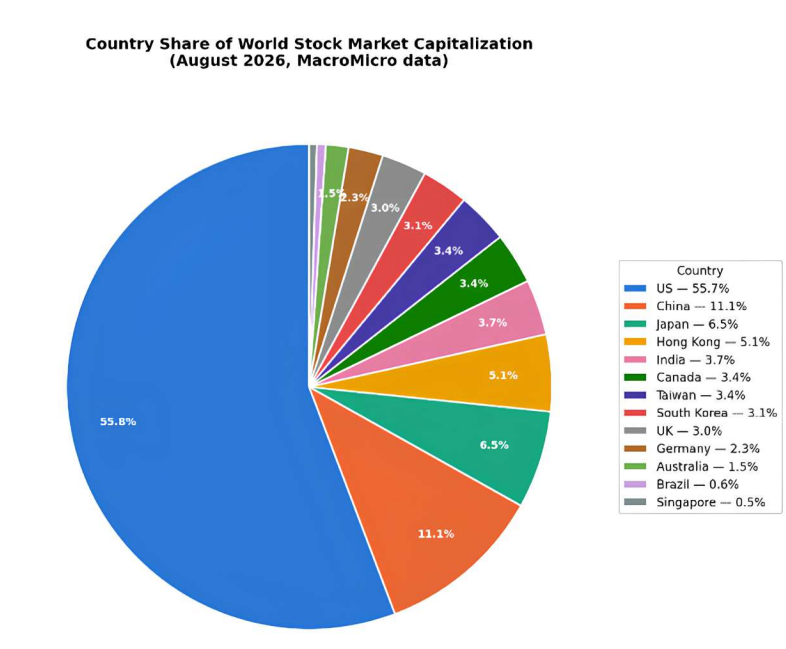
India is home to one of the world’s most compelling growth stories. But from an equity-market perspective, it represents just 3.7% of global market capitalisation. Yet, most Indian investors remain overwhelmingly concentrated in Indian markets.
The paradox is striking: we are comfortable allocating most of our wealth to less than 4% of the global listed equity universe. The other 96% may not outperform India in every cycle. But it represents businesses, economies, sectors and opportunities that an India-only portfolio simply cannot access. The US alone accounts for 55.7%, while markets such as China, Japan, Hong Kong, Taiwan and South Korea together represent ~29% of the global opportunity set.
This doesn’t mean moving away from India. It simply means looking beyond it. And there is a reason why.
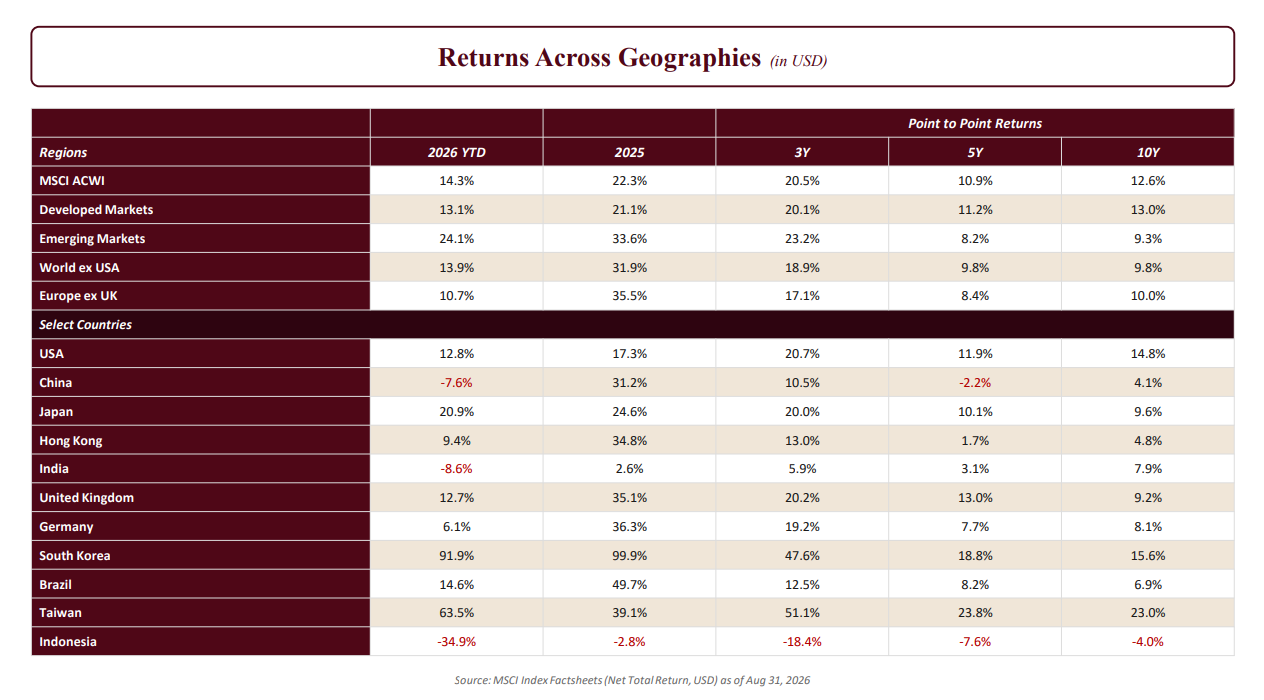
Returns across geographies can look dramatically different. In 2026 so far (as of 31 August 2026), South Korea is up 91.9%, Taiwan 63.5%, Japan 20.9% and Brazil 14.6% — while India is down 8.6% and China 7.6%. Over 3, 5 and 10 years, the leadership changes again.
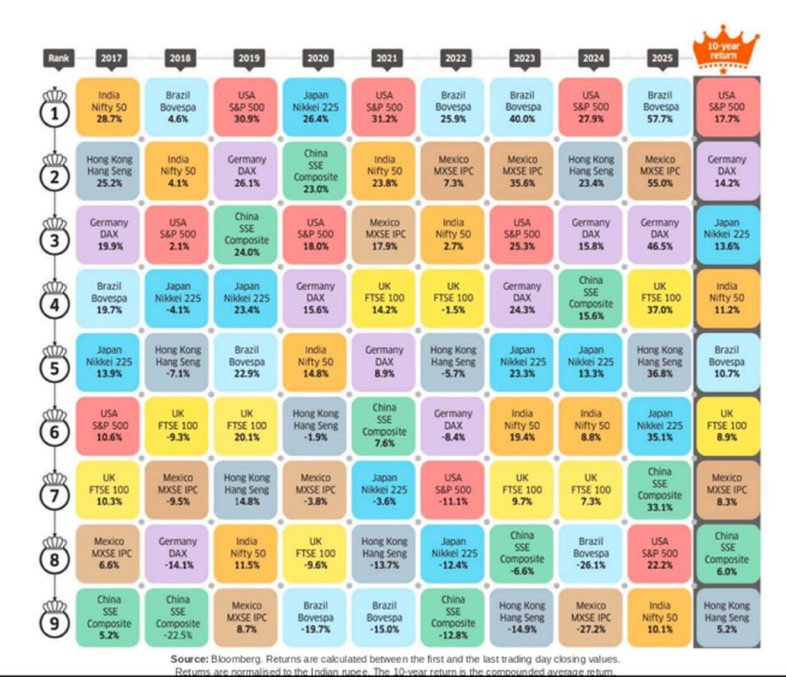
Because the reality is simple: The winners keep changing.
The last decade has seen the top spot rotate across India, the US, Japan and Brazil. There is no single geography that wins every cycle. Global investing, therefore, isn’t about predicting the next winner — it’s about ensuring that your opportunity set isn’t limited to just one.
Another consideration for Indian investors is currency. Over the last decade, the Indian rupee has depreciated against the US dollar by ~3.5% p.a. That means, while you may be earning and building wealth in rupees, the cost of assets and aspirations priced globally can become progressively more expensive in rupee terms. This is where global investing can add another dimension to diversification: not just across companies and geographies, but across currencies.
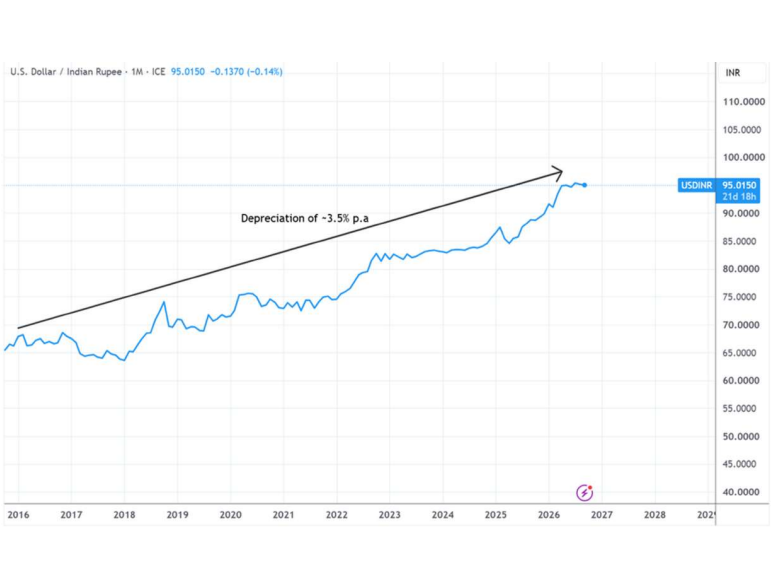
Source: Trading View | Entrust Research
Of course, this reflects a long-term trend, not a forecast — currencies can move in either direction. But when all your wealth is concentrated in a single currency, so is your currency risk.
And global investing is not synonymous with US investing.
It isn’t simply about buying the S&P 500, Nasdaq or the Magnificent 7. The opportunity spans Japan, Taiwan, South Korea, China, Europe, Brazil and beyond — each offering exposure to different economies, companies and market cycles. It also means looking beyond broad indices to the themes shaping the next decade: electrification, semiconductors, AI, defence, financials and real assets.
The question, therefore, isn’t: India or Global?
It’s: Why limit your portfolio to one geography when the world’s opportunities, across themes and sectors, are far bigger?
Global investing is not about chasing what has performed best. It is about broadening the opportunity set — across markets, currencies, sectors and investment themes.
For investors looking to take their portfolios beyond India, the right approach isn’t simply to buy what is popular or what is familiar. It is to identify where the opportunities are emerging, understand the risks that come with them, and build exposure around individual objectives, risk appetite and time horizon.
At Entrust, this is how we approach global investing — looking beyond borders, beyond benchmark-driven allocations, and across the geographies, sectors and themes shaping the global opportunity set.
Because your portfolio doesn’t have to stop where your geography does.
Every decision begins with a belief. We invest because we believe in an opportunity. We build businesses because we believe something can be done better. We prepare the next generation because we believe a legacy can evolve and endure. Those beliefs influence what we do. Our actions then change the circumstances in which we and […]
For a child who cannot hear, the challenge can extend far beyond hearing itself. It can affect how a child communicates, learns, participates in school and connects with the people around them. When support comes late, these challenges can shape a child’s opportunities well into adulthood. But early identification, the right support and an involved […]
The RBI’s 25 bps hike to 5.50% and its move from “neutral” to “calibrated tightening” came as a supply shock from West Asia pushed major central banks in the same direction. Within about a week in September, the ECB, the Fed and the Bank of Japan all raised rates while the Bank of England held […]
signup for updates