Investment Advisory

Investment Advisory
➢ Markets are not driven by growth alone. They are not driven by inflation alone.
It is the interaction between the two that shapes the investment environment.
A useful way to think about global markets is through 2 simple questions:
Put these two forces together, and four distinct economic regimes emerge.
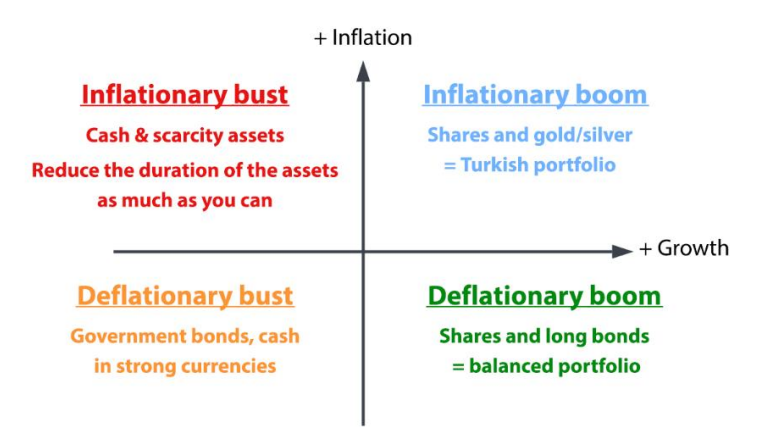
Economic activity remains strong, but inflation and interest rates are rising. In such an environment, real assets, commodities and precious metals can become increasingly relevant, while long-duration bonds may face pressure.
Growth continues while inflation remains contained. This combination can create a supportive environment for equities of innovative companies with pricing power and longer-duration assets.
The difficult combination of slowing growth and persistent inflation. Financial assets and long-duration bonds can come under pressure, while scarcity assets and stronger currencies can become more relevant.
Economic activity contracts and inflation falls. The focus typically shifts towards capital preservation, through high-quality government bonds and strong-currency cash.
➢ But how do we know which regime we’re in? This is where the framework becomes more interesting. Rather than relying only on economic headlines or short-term data, one can look at longer-term relationships between assets for clues about the prevailing environment.
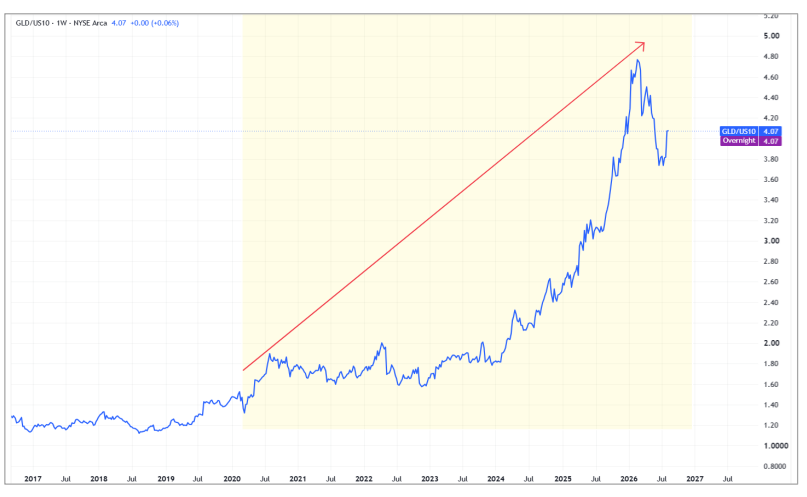
Gold tends to benefit when investors seek protection from inflation and loss of purchasing power, while long-duration government bonds tend to benefit when inflation and interest rates are falling.
If over a 5–7 year horizon:
Oil is a key input into economic activity, while equities reflect the value created by businesses. When economic activity is strong, companies can generate enough economic value to outperform the cost of energy.
If over a 5–7 year horizon:
➢ So, where are we today?
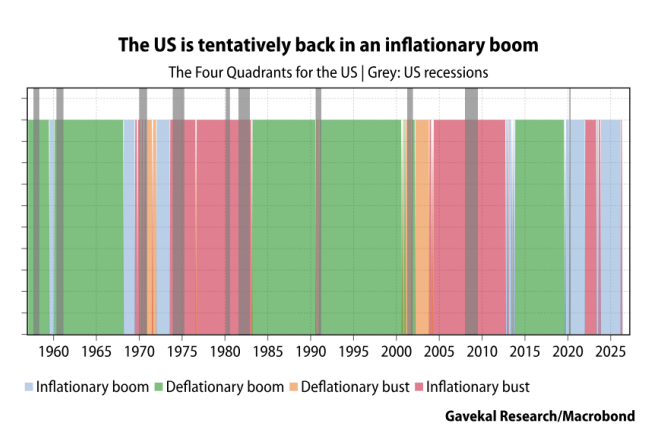
Two signals point in the same direction:
Gold has significantly outperformed long-duration US Treasuries over the recent multi-year period.
US equities have outperformed Brent crude over the longer term, suggesting that economic activity continues to generate value relative to its energy input.
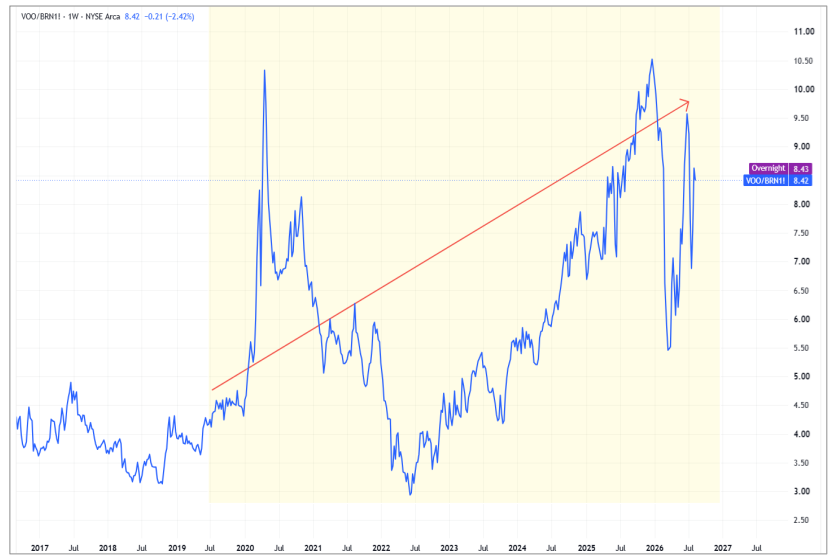
These relationships are longer-term signals. Short-term moves can be noisy, and the regime can change as the underlying relationships change.
The objective isn’t to predict every market move. It is to understand the forces driving them. Because when the economic regime changes, the assets that performed well yesterday may behave very differently tomorrow.
So, before asking “What should I buy?”, perhaps the more important questions are:
What economic environment are we in?
Do the data and market signals support that view?
Which assets tend to perform in that environment—and what allocation do they warrant?
Two questions. Four regimes. Different opportunities in each.
➢ Markets are not driven by growth alone. They are not driven by inflation alone. It is the interaction between the two that shapes the investment environment. A useful way to think about global markets is through 2 simple questions: Is economic growth rising or falling? Is inflation rising or falling? Put these two forces […]
There is an old observation about family businesses that remains relevant across generations: The first generation builds the wealth, the second manages it, and the third often struggles to preserve it. Different cultures have their own versions of this idea. In the West, there is the familiar phrase “shirtsleeves to shirtsleeves in three generations.” In […]
For a child battling cancer, the illness is only one part of the challenge. Long hospital stays, demanding treatment schedules and months away from school can disrupt education, friendships and the simple joys of childhood. While medical teams focus on treating the disease, there is another question that deserves attention: how do we help a […]
signup for updates