Founder's Perspectives

Founder's Perspectives
A Sunday of legacies, and what two great musical families taught me about the wealth that lasts
Some days stay with you. Last Sunday was one of them.
I had the privilege of being Chief Guest at Kanchanotsava 2026 in the morning, and Guest of Honour at the birth centenary celebration of Sangeeta Kalaratna Prof. H.V. Krishnamurthy in the evening. Two events. Two families. One message running through both of them like a single raga. That message was legacy.
I want to share what I saw, because I believe it speaks to something larger than music.
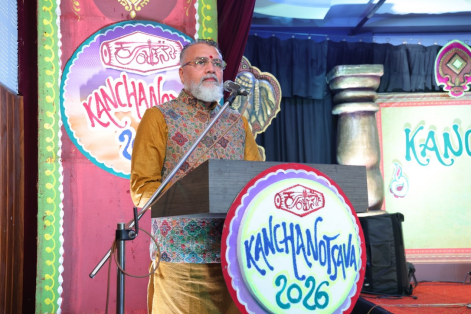
Addressing the gathering at Kanchanotsava 2026.
The day began at ten in the morning with Kanchanotsava. The festival is the work of the family of the Kanchana Sisters and Shri Kullur Jayachandra Rao. For generations, these families have held the flag of Carnatic music high. They have not done it for applause. They have done it because they believe the art must be carried forward, and someone has to carry it. The scale and sincerity of their work is overwhelming.
This year the award went to Dr. T.S. Sathyavathi. Few people embody the union of music and scholarship the way she does. She is a Carnatic vocalist, a musicologist, a Sanskrit scholar, a composer and a guru to generations of students. For her, music and Sanskrit have never been two subjects. They are one pursuit. The honour was conferred in the presence of Paramapujya Vidya Vachaspati Dr. Vishwasanthosha Bharathi Guruji, and his blessings gave the moment a sanctity that no stage design ever could.
I was simply blessed to be there.
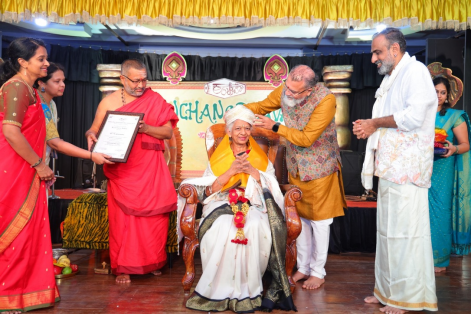
Dr. T.S. Sathyavathi is honoured at Kanchanotsava 2026, in the presence of Paramapujya Dr. Vishwasanthosha Bharathi Guruji.
The evening was something else altogether.
Vid. H.K. Venkatram and his family, including the Saralaya Sisters and Bhargavi Venkatram, organised Strings Across Traditions to mark the birth centenary of his father and guru, Prof. H.V. Krishnamurthy. HKV did not just hold a tribute. He held a gathering of an entire tradition. Violinists and veena vidwans were honoured on a single stage, the Bengaluru veena vidwans joined by one exception, the prodigious Vidwan Ramana Balachandran, who lives outside the city.
I run an organisation. I know what it takes to pull off an evening like this. The coordination, the invitations, the many sensitivities to be managed, the details to be gotten right. To do this in your father’s name, with this much grace, is unfathomable. That I was asked to be part of it was a humbling experience.
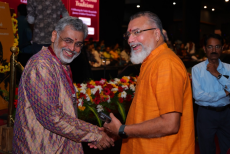
with Vid. H.K. Venkatram at Strings Across Traditions.
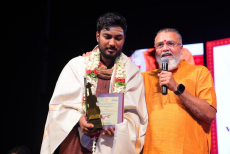
with one of the evening’s young awardees.
And then there was Dr. L. Subramaniam.
I have listened to him in awe for decades. To be seated next to him, and to be the one honouring him on behalf of Vijaya College of Music, is something I will carry with me for a long time.
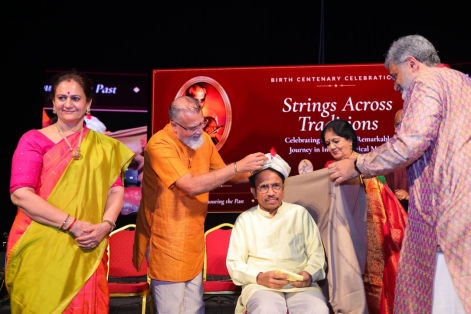
The felicitation on stage at Strings Across Traditions, the birth centenary celebration of Sangeeta Kalaratna Prof. H.V. Krishnamurthy.
When he spoke, he did not speak about his concerts or his collaborations with the world’s great orchestras. He spoke about his family.
He was born into music. His father, Prof. V. Lakshminarayana, was a violin maestro. His mother was a vocalist and veena player. His brothers played the violin. His uncles were great vocalists. Music was in the air in that house. And yet, as a young man, he was studying medicine at Madras Medical College.
When an opportunity in music came, his father wanted him to take it. That would have meant leaving his medical education unfinished. His mother stepped in. Finish your MBBS first, she told him.
He listened. He became a qualified doctor. And that degree turned out to be the key that unlocked everything that followed. Because he had completed his education, he could go to California for a Master’s in Western classical music. Then came a PhD. Then honorary doctorates from Bangalore University, the University of Madras and Sheffield University. If he had walked away from medicine halfway, he said, that Master’s would never have been possible.
Think about that. The man the world calls the Paganini of Indian music owes a turning point in his life to his mother’s quiet insistence.
He spoke of the joint family, where elders guide and everyone supports. He spoke of parents who think beyond the next opportunity to the whole life of the child. And he spoke of the irreplaceable role of a good teacher.
As I listened, I kept hearing that old line from our tradition. It is the order in which we are asked to revere. Not because God comes last, but because God reaches us first through these three people.
In Dr. Subramaniam’s story, all four were present. His mother’s wisdom. His father’s vision. His gurus’ training. And the grace that brought them together.
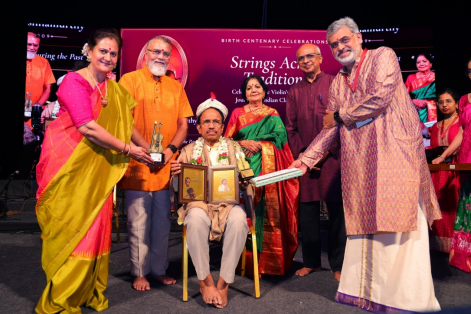
Honouring a tradition: awardees, hosts and guests on stage at Strings Across Traditions.
The day closed with a presentation of the Ramayana by HKV and his team.
Many years ago, Prof. Krishnamurthy’s own guru chose verses from the Ramayana and presented them in musical form. Prof. Krishnamurthy carried that work forward in his time. Now his son has taken it further still. Using AI, HKV created an audio-visual presentation that was simply breathtaking.
Three generations. One epic. Each generation using the tools of its time, and none of them changing the soul of the work.
That, to me, is what legacy actually looks like. It is not a museum. It is a relay.
Why am I writing all this?
At Entrust, we spend our working lives helping families think about wealth that lasts beyond a generation. We talk about structures, succession and stewardship. But what I saw on Sunday reminded me of something we often forget. The most durable wealth a family owns is not on its balance sheet. It is its values, its culture and its way of passing things on. Money that is not carried by values rarely survives three generations. Culture that is carried by family can survive centuries.
The Kanchana and Kullur families, the Krishnamurthy family, the Lakshminarayana family. None of them preserved Bharatiya sanskriti by talking about it. They preserved it by living it at home, teaching it to their children, and showing up year after year.
Our value systems are under strain today. Families are smaller and busier. Children are pulled in many directions. It is easy to think culture will look after itself. It will not. It needs mothers who say finish what you started. Fathers who see further. Teachers who give everything. And families willing to hold the flag a little longer.
I came home on Sunday night grateful. And with one question for myself. What am I passing on?
A Sunday of legacies, and what two great musical families taught me about the wealth that lasts Some days stay with you. Last Sunday was one of them. I had the privilege of being Chief Guest at Kanchanotsava 2026 in the morning, and Guest of Honour at the birth centenary celebration of Sangeeta Kalaratna Prof. […]
Every decision begins with a belief. We invest because we believe in an opportunity. We build businesses because we believe something can be done better. We prepare the next generation because we believe a legacy can evolve and endure. Those beliefs influence what we do. Our actions then change the circumstances in which we and […]
For a child who cannot hear, the challenge can extend far beyond hearing itself. It can affect how a child communicates, learns, participates in school and connects with the people around them. When support comes late, these challenges can shape a child’s opportunities well into adulthood. But early identification, the right support and an involved […]
signup for updates