Founder's Perspectives

Founder's Perspectives
Most years, when a weak monsoon turns into a June headline, the headline carries more weight than the number underneath it. This year I want to say something different before making the rest of the argument, because the difference is worth taking seriously. The 2026 monsoon carries the weakest official forecast since 2015. June came in among the driest in more than a century of records. The Reserve Bank has already lowered its own growth forecast for the year ahead, and named the rainfall outlook as one of its reasons. Given all that, the case for staying calm should be harder to make than usual this year. I don’t think it is, and I want to walk through why.
There is a habit that surfaces every year around this time, in boardrooms as much as in kitchens. A season looks dry, a number gets quoted, and a word like “El Niño” is left to carry a conclusion it was never built to carry. Call it the single-word diagnosis. It treats one below-normal monsoon as interchangeable with any other, when the size of the shortfall, the month it falls in, the crops it touches and the structure of the economy underneath it all change from year to year. Naming this habit is not the same as excusing bad news. It is the difference between reading a number and reading a headline about a number.
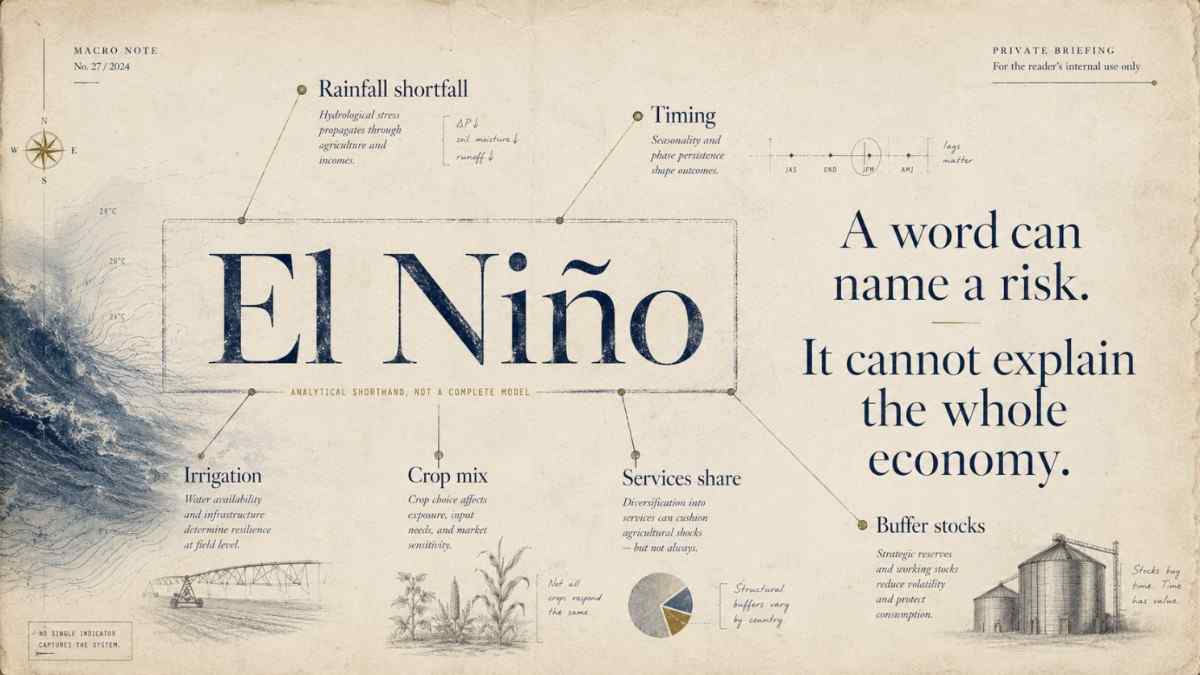
The 2026 numbers, in plain terms: the India Meteorological Department has forecast seasonal rainfall at roughly 90 percent of the long-period average, the weakest outlook in over a decade and the first below-normal season in three years. June arrived close to 40 percent short of normal, among the driest since records began in 1901, with the monsoon’s advance running roughly ten days behind schedule. July, which usually carries the largest share of the season’s rain and much of the sowing window for rice, pulses and oilseeds, is forecast to fall short of normal too. In 2019, a positive Indian Ocean Dipole rescued a similarly worrying June, pushing the season to a comfortable surplus by September. The Dipole sits neutral for now, and even India’s own meteorological department says it is too early to know whether a compensating shift will arrive later in the season. The cushion that saved 2019 is not obviously present this time.
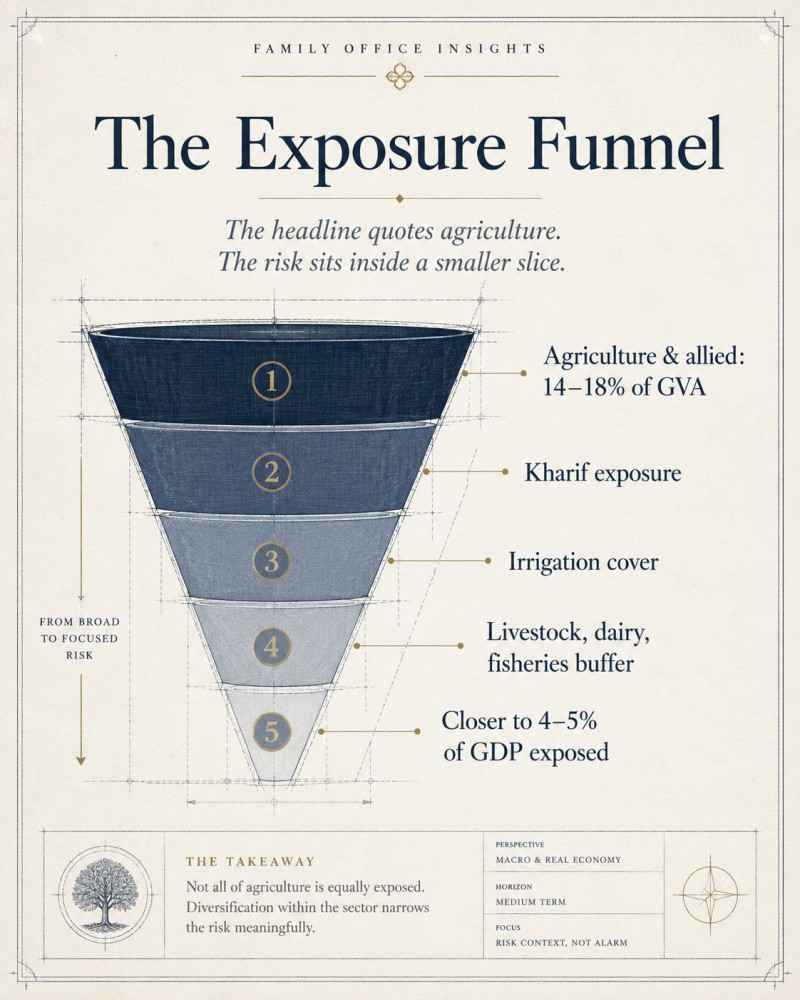
None of this changes the underlying arithmetic of how much of the economy depends on a single season’s rain, and that arithmetic is worth doing slowly, because it is where most of the anxiety dissolves once you look closely. Agriculture and its allied activities make up somewhere between 14 and 18 percent of India’s gross value added, depending on how the number is measured. Only the Kharif season, sown with the monsoon and harvested by autumn, depends directly on it; Rabi crops rely mainly on winter moisture and irrigation. Kharif and Rabi production run close to an even split by volume, which puts the maximum direct exposure to a poor monsoon near 8 percent of GDP, a ceiling rather than a realistic estimate.
Two further adjustments narrow that ceiling considerably. India’s irrigated share of net sown area has grown from roughly 40 percent two decades ago to about 55 percent now, so more than half of even the monsoon-dependent Kharif crop carries some protection against a bad season. And within agricultural output, livestock, dairying and fisheries, activities that barely notice a dry June, now make up close to 45 percent of the total. Put these adjustments together and the portion of the economy exposed to a single season’s rainfall sits closer to 4 or 5 percent of GDP than the 16 percent most headlines quote.
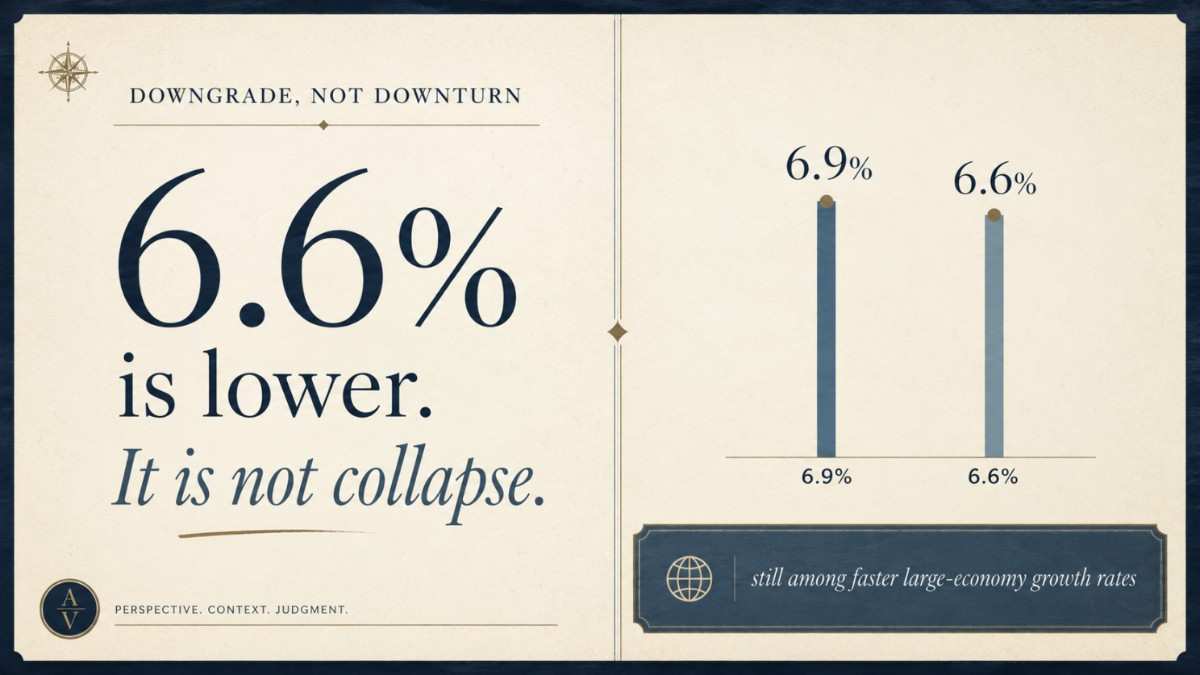
That is the argument I would have made in most years, and I still believe it. But it would understate the picture to stop there, because this year the caution has moved somewhere it usually does not: inside the institution meant to be the calmest voice in the room. The Reserve Bank’s own June review trimmed its growth forecast for the year ahead from 6.9 to 6.6 percent, and raised its inflation projection from 4.6 to 5.1 percent, naming the monsoon outlook among the reasons for both. It is not a dramatic sentence. It sits inside a routine paragraph of a routine bulletin, the kind of line that moves a handful of analysts and no headlines at all. That is exactly why it is worth noticing. When caution shows up in the quiet paragraph rather than the loud one, it usually means an institution takes something seriously enough to act on, and not seriously enough to alarm anyone with.

It is worth sitting with what 6.6 percent actually means before treating it as bad news. It is a full percentage point below what India posted in the year just closed, and it would still sit among the faster growth rates of any large economy this year. A downgrade is not the same event as a downturn. The two get confused often, and the confusion is where most of the anxiety in these headlines lives.
The deeper reason a serious monsoon no longer threatens the economy the way it once did is structural, and it did not happen this year. At independence, agriculture carried more than half of the country’s value added. Today it carries under a fifth, while services, largely indifferent to rainfall and increasingly digital, carry more than half. Grain buffer stocks give food security a floor that did not exist through most of the twentieth century. Crop insurance and minimum support prices, imperfect as their reach still is, cushion farm incomes in years like this one in ways earlier generations of farmers did not have. None of it was built with 2026 in mind. It accumulated, over five decades, into a different kind of economy than the one a bad monsoon used to be able to threaten.
For a family office, or for a family managing wealth across generations, the useful question is rarely whether the monsoon will disappoint this year. It usually will, to some degree; some years it will not. The useful question is whether a business, a portfolio or a household has been built in a way that requires the monsoon’s cooperation to hold steady. The discipline is not in predicting the rain. It is in building something that does not need to.

None of this makes the season easier for the households living through it. Water stress is real this year in a way it was not in several recent ones. Food prices will likely feel it before the year is out, and rural incomes will feel it before food prices do. A structural argument about GDP percentages is true at the level of the economy and close to irrelevant at the level of a family deciding what to plant, or what to skip buying, this season. Both are true together, and neither cancels the other.
The monsoon has not stopped mattering to India. It has simply stopped being able to decide, on its own, how the country’s year turns out. This is the year that claim gets tested more seriously than it has been in over a decade. So far, it appears to be holding.

Every decision begins with a belief. We invest because we believe in an opportunity. We build businesses because we believe something can be done better. We prepare the next generation because we believe a legacy can evolve and endure. Those beliefs influence what we do. Our actions then change the circumstances in which we and […]
For a child who cannot hear, the challenge can extend far beyond hearing itself. It can affect how a child communicates, learns, participates in school and connects with the people around them. When support comes late, these challenges can shape a child’s opportunities well into adulthood. But early identification, the right support and an involved […]
The RBI’s 25 bps hike to 5.50% and its move from “neutral” to “calibrated tightening” came as a supply shock from West Asia pushed major central banks in the same direction. Within about a week in September, the ECB, the Fed and the Bank of Japan all raised rates while the Bank of England held […]
signup for updates