Founder's Perspectives

Founder's Perspectives
That sentence holds more succession cases than any legal brief. And it points to the gap that private trusts, at their most useful, are designed to close.
A The Times Of India report recently noted that affluent families in Gujarat are turning to private trusts for wealth succession in growing numbers. The reasons cited were practical: dispute reduction, probate avoidance, asset protection, business continuity, and protecting dependents who may not be positioned to manage what they inherit. These are all legitimate drivers. But beneath them is a quieter, more honest reason that most families do not say aloud: they are trying to protect the interpretation of a life’s work, not just its monetary value.

This is not only a legal distinction. It is a temporal one.
A will is a document written at one point in time, to be executed at another. The gap between those two moments is often decades. In those decades, families change in ways that cannot be fully predicted. Children grow into people with their own convictions and competing loyalties. New relationships form. Old understandings become contested. The phrase spoken with great confidence, “I trust you all to work it out together,” becomes the exact sentence no one can agree on.
A private trust, designed with care, does something different. It attempts to encode the original intention: what the wealth is for, who should be responsible for decisions about it, how disagreements should be handled, and what should happen when circumstances move beyond the original plan.
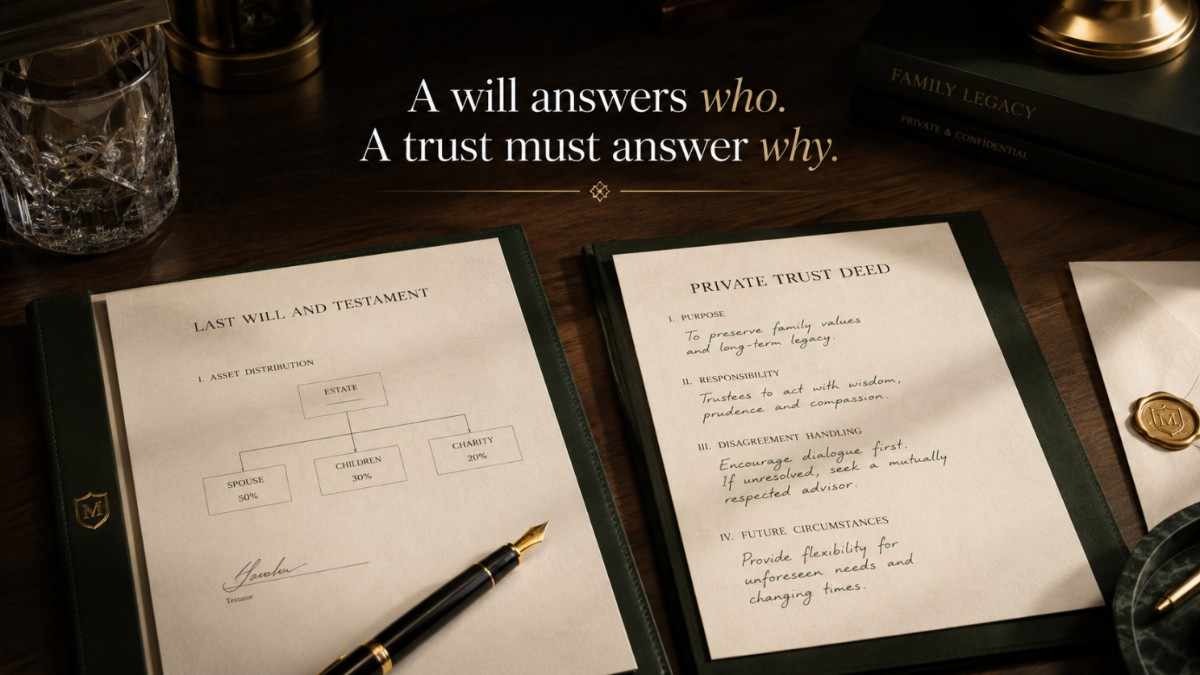
That is a harder task than distributing assets. And it requires a family to have a conversation that most prefer to defer.
A trust is only as reliable as the trustee who administers it. And the trustee question is where many families make their most consequential error.
The selection of a trustee is often treated as an administrative decision: who is reliable, who understands the finances, who is senior enough within the family? These are reasonable starting points. They are not sufficient ones.
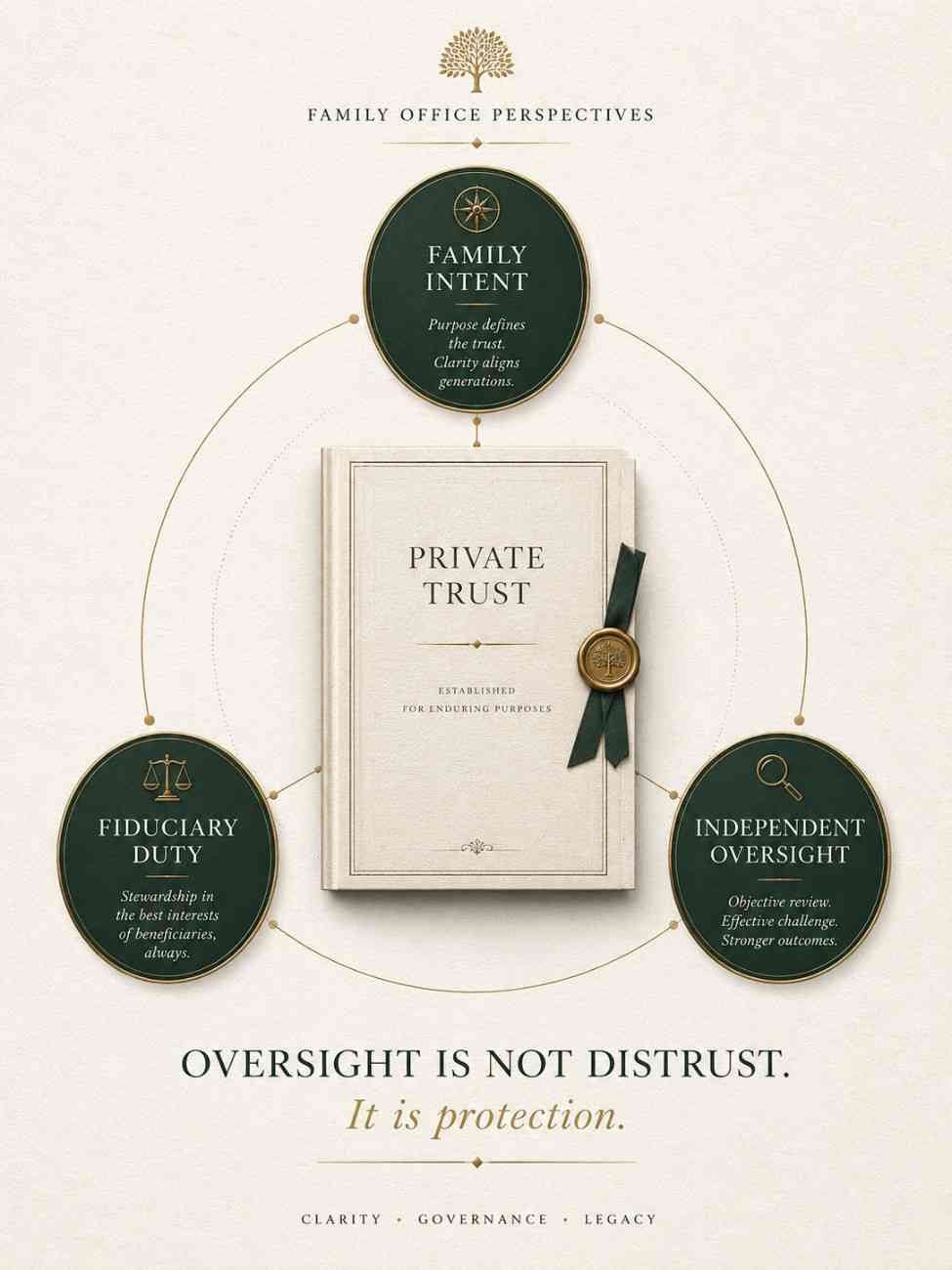
A trustee carries the responsibility of interpreting intent when the person who held that intent is no longer present. This is a specific and demanding function. It requires someone who can hold family relationships with care while enforcing a framework that may be uncomfortable to enforce. Someone who can say, in good conscience: this is what was meant, and this is how I will honour it, even when that creates friction.
The most trusted member of a family is not automatically the right trustee. Social trust, the kind built through shared history and affection, is different from the discipline required for fiduciary accountability. Families that conflate the two often build structures that are technically sound but behaviourally fragile.

This is one of the reasons that professional co-trustees or independent oversight mechanisms are becoming part of how serious succession structures are designed. Not as a statement of distrust, but as an acknowledgment that the role carries a weight that should not be held alone.
The most difficult moment in any succession is not the legal dispute itself. It is the moment when two people who grew up in the same house, who loved the same person, begin to describe that person’s intentions in entirely different ways.
“He always said the business was mine to run.”
“She always said we should decide together.”
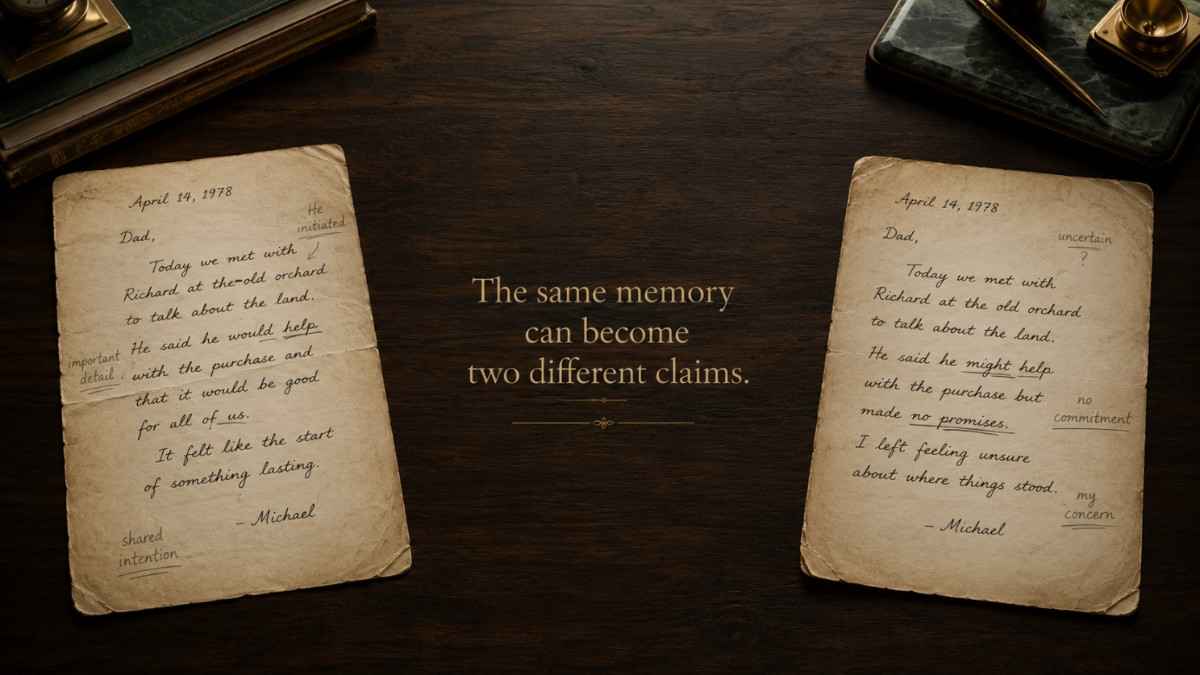
Both statements can be genuine. Both can also be shaped by what each person needed to believe. Without a structure that recorded the original intention clearly, without a framework that preserved the reasoning behind the plan, there is no resolution that does not cost someone something real.
This is rarely a legal failure. It is almost always a documentation failure. And behind that documentation failure is a conversation that was never had. The structure was not built because the conversation was deferred. And the conversation was deferred because everyone assumed there was time.

Succession planning begins when the family is still able to talk.
In Wise Wealth, I wrote about the idea that wealth without continuity structures dissolves over time, not through a single event, but through the accumulation of unresolved ambiguity. The generation that builds wealth typically holds it together through presence, authority, and personality. The generation that inherits must hold it together through something more durable: shared understanding, written frameworks, and the kind of clarity that survives disagreement.
Through our work with families at Entrust Family Office, the pattern I observe most consistently is this: families that plan well are rarely the ones with the most sophisticated legal structures. They are the ones who had the harder conversations earlier.
Those conversations are about what the wealth is for. About which relationships must be protected even while assets are being divided. About what the people who come next should understand about why this was all built in the first place.
The growing adoption of private trusts among Indian business families is a signal worth reading carefully. The reasons most cited are relational rather than purely transactional: protecting dependents, reducing dispute risk, ensuring continuity when a single unifying presence is no longer there.
For decades, Indian family wealth was held together by individual authority: a founder’s presence, a patriarch’s word, a matriarch’s quiet structuring of relationships and expectations. What families are beginning to recognise is that no structure built on personality alone is designed to outlast its architect.
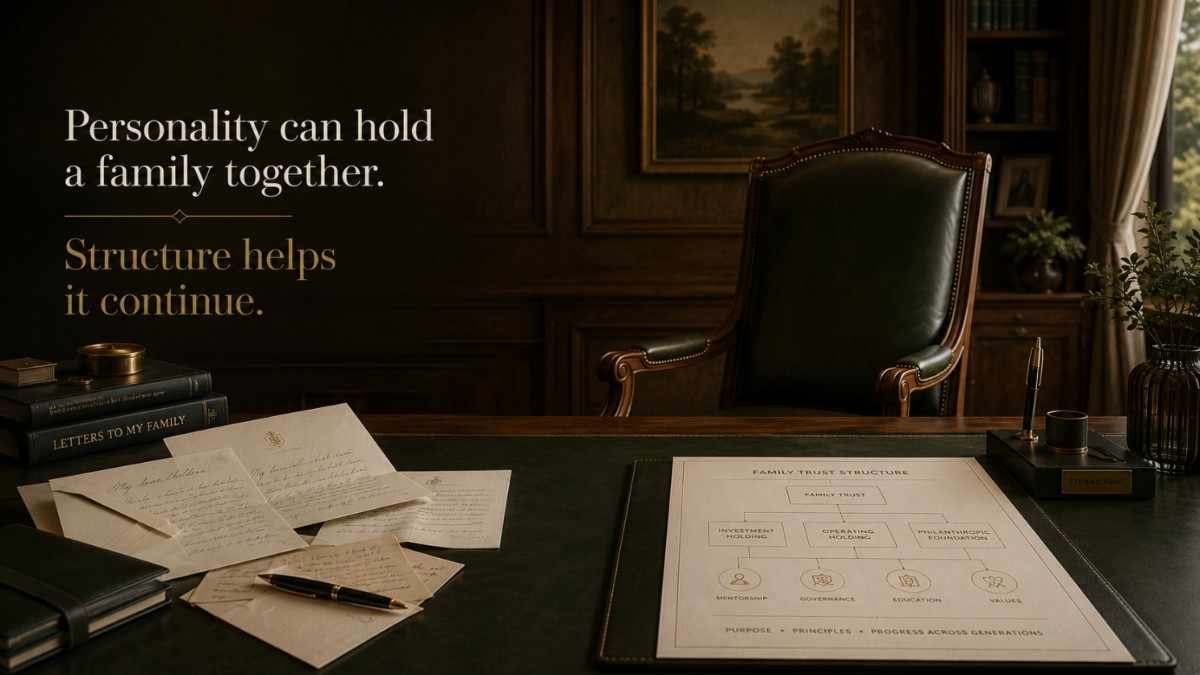
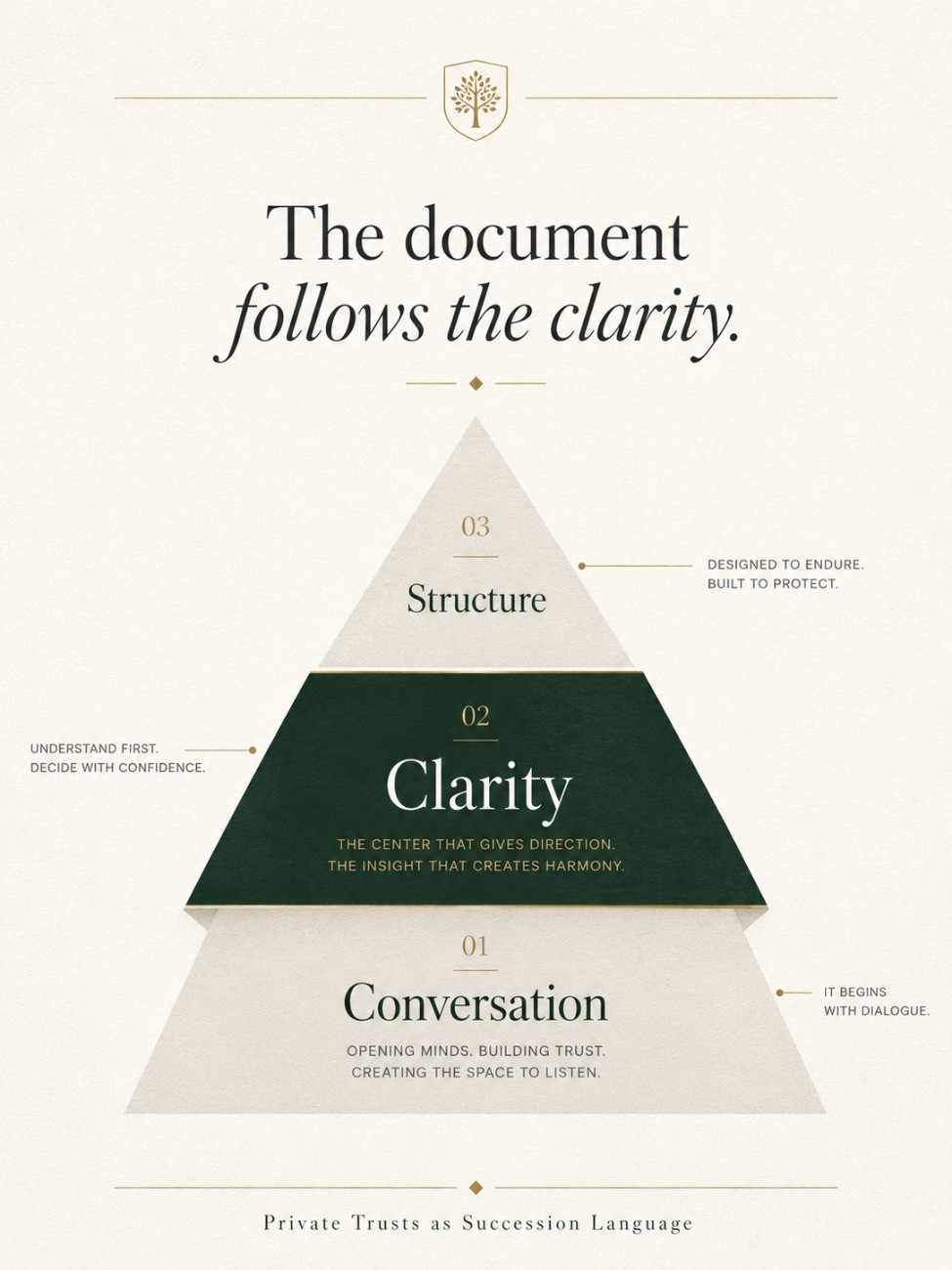
For families still in the consideration phase, the most important principle is straightforward: a private trust is not the starting point for succession planning. It is the formalisation of a conversation that should come first.
The document follows the clarity. It cannot create clarity that was never there.
What should a family clarify while everyone is still willing to listen?
That question, taken seriously, is worth more than any structure built without the answer.
Every decision begins with a belief. We invest because we believe in an opportunity. We build businesses because we believe something can be done better. We prepare the next generation because we believe a legacy can evolve and endure. Those beliefs influence what we do. Our actions then change the circumstances in which we and […]
For a child who cannot hear, the challenge can extend far beyond hearing itself. It can affect how a child communicates, learns, participates in school and connects with the people around them. When support comes late, these challenges can shape a child’s opportunities well into adulthood. But early identification, the right support and an involved […]
The RBI’s 25 bps hike to 5.50% and its move from “neutral” to “calibrated tightening” came as a supply shock from West Asia pushed major central banks in the same direction. Within about a week in September, the ECB, the Fed and the Bank of Japan all raised rates while the Bank of England held […]
signup for updates