Investment Advisory

Investment Advisory
Financial markets regularly face crises – financial scandals, wars, inflation shocks, banking failures, pandemic, geopolitical stress, etc.
Each time markets fall sharply, investors ask the same question: “Is this the time to exit?”
History suggests the opposite.
Across decades of market data, crises have typically created temporary volatility but long-term opportunity.
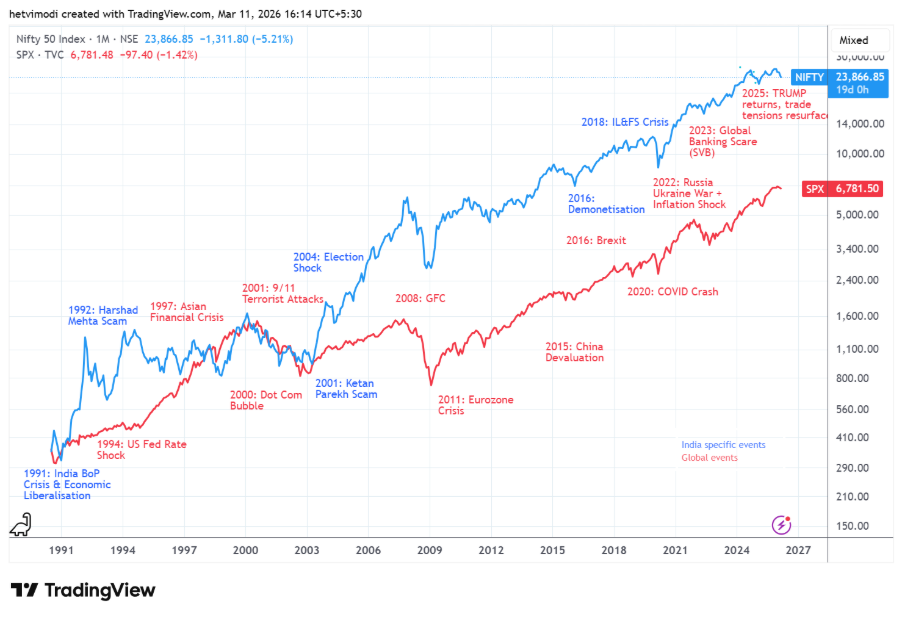
Over the past century, the S&P 500 has delivered roughly 9–10% annualised returns, navigating events such as the Great Depression, World Wars, oil shocks, the dot-com collapse, the Global Financial Crisis and the COVID-19 pandemic.
A similar pattern exists in India.
Since the mid-1990s, the Nifty 50 has compounded at approximately 13–14% annually, despite disruptions including the Asian Financial Crisis, the Global Financial Crisis, demonetisation, the IL&FS credit crisis and the COVID shock.
In other words, volatility has been frequent, but long-term compounding has remained intact.
Market declines during crises can be severe.

During the Global Financial Crisis, Indian equities fell nearly ~65% & S&P 500 58% from peak to trough.
Similarly, the COVID crash of 2020 saw the S&P 500 and Nifty 50 decline roughly 35% & 40% respectively within weeks, one of the fastest corrections in modern history.
Yet the recovery was equally dramatic.
Historical data suggests that market crashes in India have typically lasted around 8 months, while recoveries to previous highs often occurred within 16 months on average.
One of the biggest risks for investors during crises is attempting to exit markets and re-enter later.
Research shows that many of the market’s best days occur shortly after the worst declines.
Missing even a handful of these days can dramatically reduce long-term returns.
For example: According to J.P. Morgan, U.S. equities have delivered roughly ~10% annual returns over the long term, but missing just the 10 best trading days can cut those returns nearly in half compared to staying invested throughout.
This makes market timing during periods of volatility extremely difficult.
Some of the strongest market rallies in history have begun during periods of peak pessimism.
After the 2009 bottom during the Global Financial Crisis, global equities entered one of the longest bull markets in history.
Similarly, investors who deployed capital during the COVID-19 market panic in March 2020 saw significant gains in the years that followed. From the pandemic lows, equity markets delivered roughly ~172% returns in the US and nearly ~200% in India over the subsequent 5 years.
These episodes highlight a recurring pattern: the moments that feel most uncomfortable often create the most attractive long-term opportunities.
Financial markets are forward-looking.
Prices reflect expectations about future earnings, policy responses and economic recovery.
As a result, markets often begin rising while economic news still appears negative.
This is why many recoveries start when investor sentiment is still cautious.
Crises will continue to occur but history suggests that short-term volatility has rarely prevented long-term wealth creation.
While the current global environment presents its own set of unique uncertainties and that history may or may not repeat itself exactly, at Entrust we believe that disciplined investing that is anchored in diversified asset allocation, avoiding emotion driven decisions, a strong focus on long-term fundamentals and staying invested through market cycles, can help investors navigate these uncertainties while staying aligned with long-term wealth creation.
For patient investors, periods of crisis have often been the starting point of the next phase of wealth creation.
Financial markets regularly face crises – financial scandals, wars, inflation shocks, banking failures, pandemic, geopolitical stress, etc. Each time markets fall sharply, investors ask the same question: “Is this the time to exit?” History suggests the opposite. Across decades of market data, crises have typically created temporary volatility but long-term opportunity. Markets Have Compounded Despite […]
In this edition of our Philanthropy section, we spotlight an initiative working to address one of India’s most critical education challenges: foundational reading. Across the country, millions of children struggle with basic literacy. According to the ASER 2024 report, 55% of students in Grade 5 are unable to read a Grade 2 level text. When […]
As families grow and wealth becomes more diversified, one important question often arises: how can wealth be transferred fairly among children when certain assets, such as businesses or legacy real estate, cannot be easily divided? This is where estate equalisation becomes relevant. Rather than splitting every asset equally, families allocate assets thoughtfully and use financial […]
signup for updates