Founder's Perspectives
Founder's Perspectives
There is a question I hear more often now, even from families who have been giving quietly for decades, and it is not the question people expect.
It is not, “How much should we give?”
It is, “Why does our giving still feel scattered?”
The discomfort behind that question is real. The family is sincere. The intent is sincere. The cheques go out on time. The founders and the next generation both care. And yet, when they look back after a few years, they sense something unfinished, as if the generosity travelled, but the change did not fully arrive.
This is why the most interesting shift in philanthropy right now is not about scale. It is about design.
A recent global report on Trends in Philanthropy 2026 on UBScaptures this clearly: philanthropy is no longer an adjunct to wealth. It is increasingly becoming a core pillar of how families steward capital, values, and legacy. It is also becoming more professional, more integrated, and far more demanding of governance than it used to be.
Over the last decade at Entrust Family Office, we have been watching the same evolution unfold in India, in its own language and rhythm.
India has always had daan, community giving, temple giving, school building, hospital wards, feeding programmes, the quiet habit of supporting what is close and familiar. What is changing now, particularly among UHNIs and entrepreneurial families, is the level of intentionality they want from themselves. The questions are becoming sharper. Families are moving beyond writing cheques to asking whether they are treating symptoms or changing the conditions that create them.
What I find encouraging is that these questions are not ideological. They are practical, even personal.
Are we funding outcomes that will keep repeating every year, or are we reducing the need for funding over time?
Are we simply supporting good organisations, or are we strengthening the system those organisations are trying to operate within?
Are we giving money, or are we using the full reach of the family’s capabilities to make the money matter?
The report uses a phrase I like: impact moving from silo to spectrum, where philanthropy is no longer confined to a foundation or a grant programme, but embedded across the family’s wider ecosystem. What this means in real life is not complicated to say, but it is demanding to do.
A family may have a business that employs thousands. It may have an investment portfolio that funds industries and shapes incentives. It may own real estate and influence urban development. It may have credibility with regulators, access to policymakers, and relationships that open doors others cannot even find. If the family’s philanthropic intent sits in one corner, while the business, the portfolio, and the public posture move in another direction, the family ends up living with contradictions. And contradictions are costly, not just reputationally, but internally.
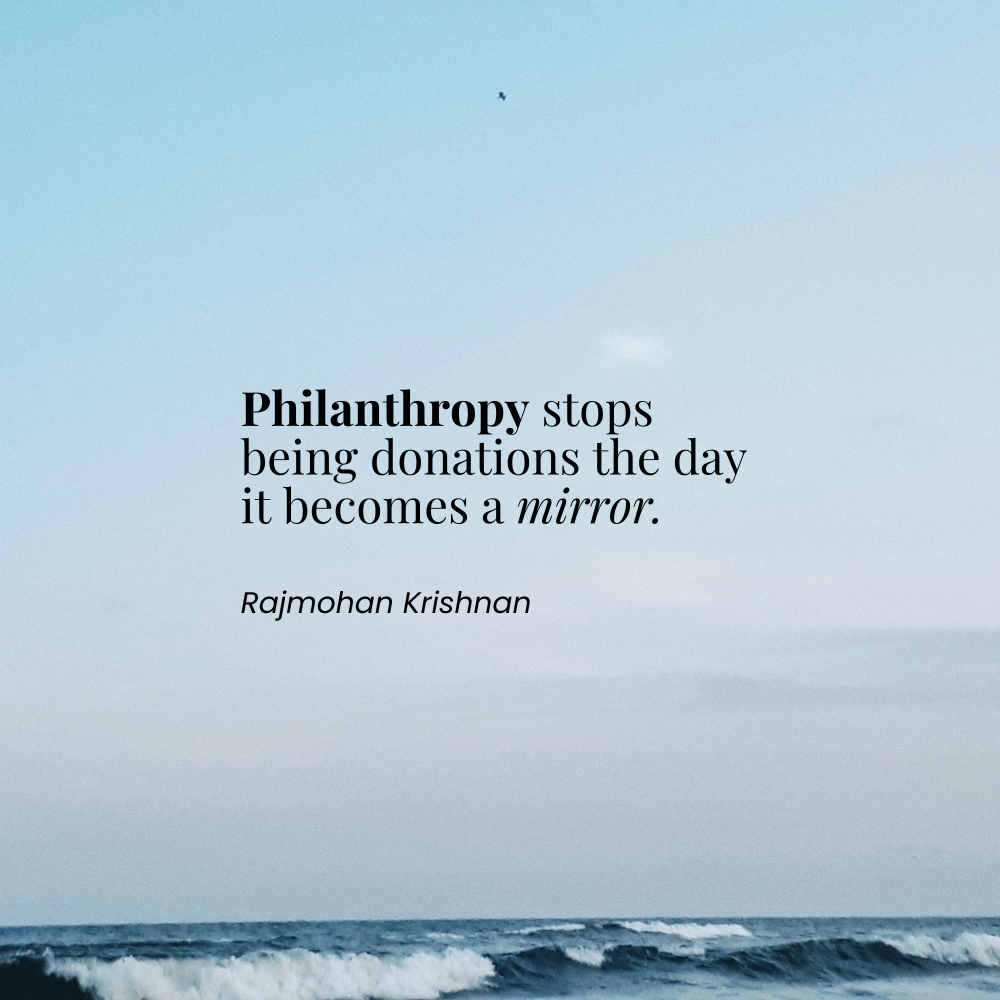
I have learned this through conversations more than through spreadsheets. There is a particular moment that repeats itself in family discussions. Someone in the room, often quietly, says something like, “We care about education, but our investments do not reflect that concern.” Or, “We care about healthcare, but we are not sure where we are actually enabling harm.” That is when philanthropy stops being a list of donations and becomes what it always should have been: a mirror.
This is also where the role of the family office is changing.
The report describes family offices expanding beyond grant administration, becoming the interface between purpose and execution: setting mandates, aligning reporting, and connecting investment, philanthropy, and external engagement. I recognise that description because it is increasingly the work.
A family office, when it is at its best, is not merely an administrator of capital. It is an architecture of alignment. It helps a family move from good intent to consistent action, without letting the family’s own complexity dilute the mission.
This shift also asks for humility. Philanthropy is deeply personal, but it is no longer casual. It now requires tools, evidence, and specialised capability, and not every family needs to build everything in-house. The report notes that many families managing philanthropy internally are building impact expertise alongside their legal, tax, and investment competencies, while others access external partners as they develop the skills needed.
At Entrust, we took an early step toward learning by doing when we established the Entrust Foundation nearly a decade ago. The intent was not to build scale for its own sake. It was to build depth and integrity, to engage with causes we believe in, and to develop internal muscle so we could serve our clients with greater realism. That experience taught me something simple: philanthropy becomes more effective the day it becomes more accountable, not to public applause, but to the family’s own standards.
One of the strongest ideas in the report is the concept of “poly-capital.” It is a reminder that families can deploy far more than financial capital: networks, knowledge, influence, governance capability, convening power, and reputation.
In India, this matters because many of our challenges are not solved by money alone. Education, healthcare, livelihoods, climate resilience, and urban systems often require coordination across public institutions, private enterprise, philanthropy, and community leadership. Capital can help, but coordination is the real scarcity.
When families begin to use poly-capital well, a quiet change happens. The giving becomes less performative and more infrastructural. The family begins to ask, “Where can we be catalytic?” not in the fashionable sense of the word, but in the precise sense: where can we take risk that others cannot take, fund work that is too early for markets, and stay patient when outcomes require time?
This is also where philanthropy in 2026 begins to intersect with public policy and partnerships.
Globally, governments are actively courting family capital through incentives, structured vehicles, and public-private programmes that offer more designed, de-risked pathways for impact. The report points to jurisdictions and frameworks that are being built for this purpose, and how family offices are increasingly participating through structured partnerships.
India’s framework is evolving, sometimes unevenly, but the opportunity is real. When public-private collaboration is thoughtfully designed, and when families engage with the seriousness of governance rather than the romance of charity, impact can scale beyond what any one institution can do alone.
What I have come to believe is this: philanthropy in 2026 is no longer about generosity alone. It is about stewardship, strategy, and systems, and the ability to hold all three without losing the tenderness that made the giving begin.
The families who will shape this next chapter are not necessarily the ones who give the most money. They are the ones who are willing to integrate their intent across the balance sheet, across decision-making, and across generations, so that their capital does not contradict their conscience.
If there is one shift I would like to see more families make, it is this: move from asking, “What cause do we support?” to asking, “What outcome are we building, and what must we align so it can endure?”
Because in the end, the most meaningful philanthropy does not merely distribute wealth.
It reduces the need for future charity by strengthening what is fragile, and by building what is missing.
And when that happens, a family’s legacy is not something spoken about later.
It is something quietly constructed in the present.
Every decision begins with a belief. We invest because we believe in an opportunity. We build businesses because we believe something can be done better. We prepare the next generation because we believe a legacy can evolve and endure. Those beliefs influence what we do. Our actions then change the circumstances in which we and […]
For a child who cannot hear, the challenge can extend far beyond hearing itself. It can affect how a child communicates, learns, participates in school and connects with the people around them. When support comes late, these challenges can shape a child’s opportunities well into adulthood. But early identification, the right support and an involved […]
The RBI’s 25 bps hike to 5.50% and its move from “neutral” to “calibrated tightening” came as a supply shock from West Asia pushed major central banks in the same direction. Within about a week in September, the ECB, the Fed and the Bank of Japan all raised rates while the Bank of England held […]
signup for updates