Founder's Perspectives

Founder's Perspectives
Three forces are reshaping the world families will inherit, protect, and lead through.
In our work with families over the years, one lesson has become increasingly clear: wealth is never held in isolation from the world around it. It is shaped by markets, institutions, technology, climate, politics, family dynamics, and the choices made across generations.
At Entrust Family Office, our responsibility has therefore never been limited to the management of capital. Families entrust us with continuity, responsibility, privacy, judgement, and the careful architecture that helps wealth remain wise over time.
Today, three forces are moving with unusual speed and consequence. Artificial intelligence is changing how decisions are made and how work is valued. Climate stress is moving from environmental concern to financial and social reality. Geopolitical fragmentation is weakening many of the global assumptions on which families, businesses, and markets have depended for decades.
Each of these risks is significant on its own. The deeper concern is that they are no longer separate. They interact, accelerate one another, and test systems that were built for a more predictable age.
For families of significant wealth, this is not an abstract conversation. It affects capital allocation, business continuity, education, health, residence planning, philanthropy, governance, and the preparation of the next generation.
This newsletter is not written to create anxiety. It is written to encourage clarity. In periods of structural change, the families that endure are rarely those who react the fastest. They are the ones that prepare the most thoughtfully.
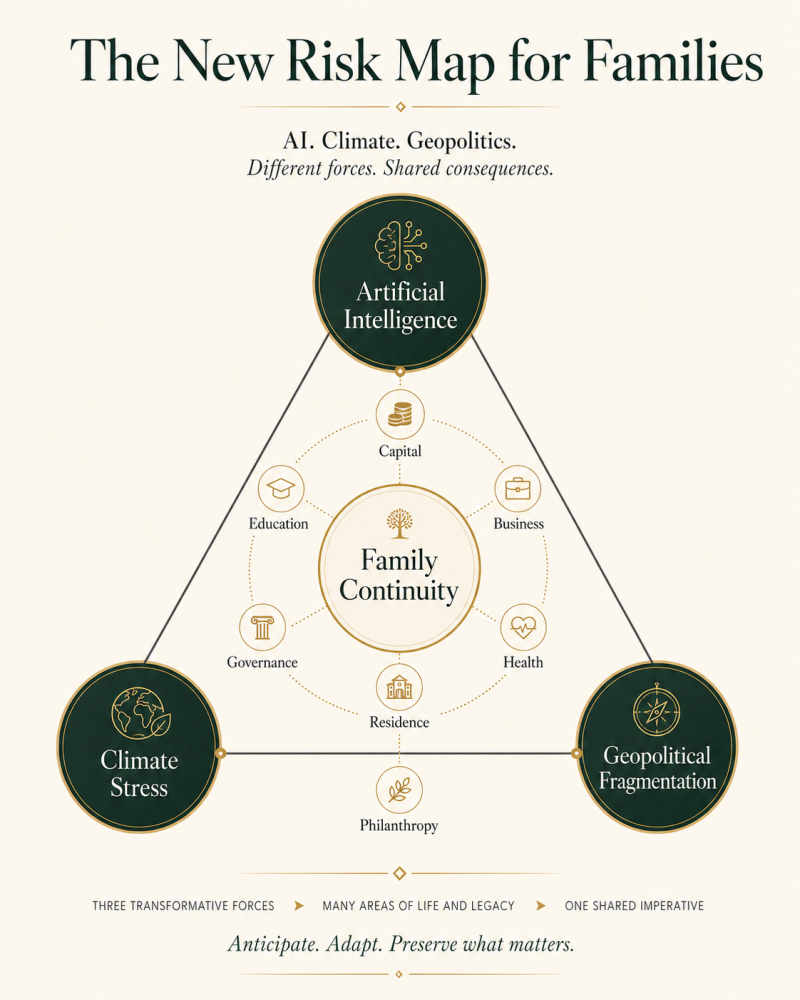
The risk is not only technological. It is institutional, economic, and human.
Artificial intelligence is advancing faster than most legal frameworks, ethical systems, and labour markets can adapt. The larger shift is not only about automation, but about the growing role of AI in consequential decisions across finance, medicine, education, defence, law, hiring, security, and governance.
For families and enterprises, the implications are direct. Businesses may need to rethink talent, productivity, cybersecurity, intellectual property, succession, and operating models. Younger family members will enter a world where traditional education and conventional career paths may not offer the certainty they once did.
The real issue is not whether AI will create opportunity. It will. The question is whether families are preparing for the disruption that comes with that opportunity.

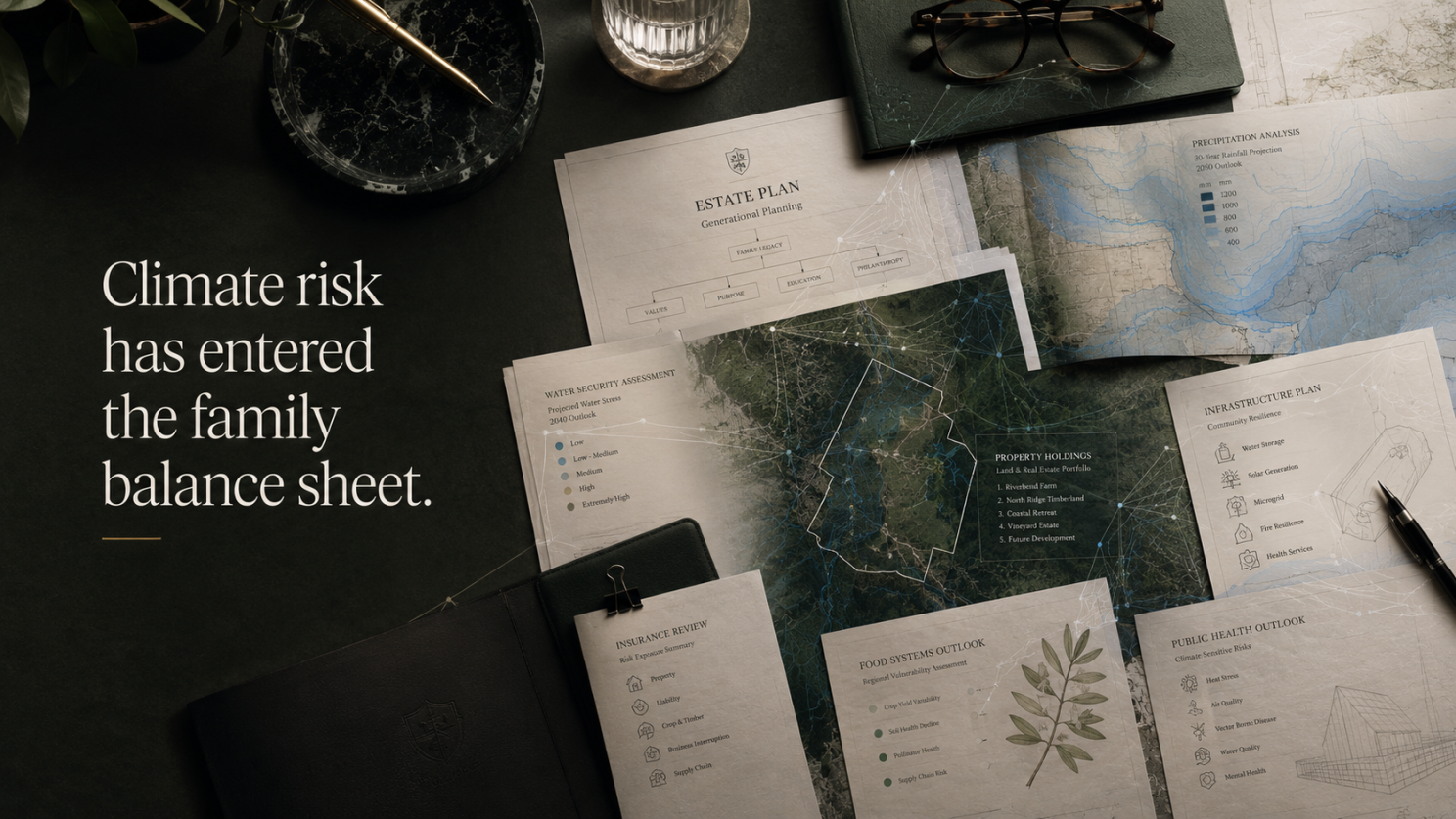
The concern is no longer environmental alone. It is financial, social, and generational.
Climate change is increasingly visible in the systems families depend upon: food, water, energy, infrastructure, insurance, public health, migration, and real estate. What was once discussed primarily as an environmental issue is now becoming a planning issue for governments, companies, investors, and families.
For long-term family capital, this has practical consequences. Assets that appear secure today may carry hidden climate exposure. Businesses may face operational disruption. Philanthropic priorities may need to shift toward resilience, adaptation, and public systems. Families may also need to think more carefully about where future generations study, live, work, and build.
The important shift is this: climate risk is no longer a specialist subject. It is becoming part of every serious conversation about continuity.
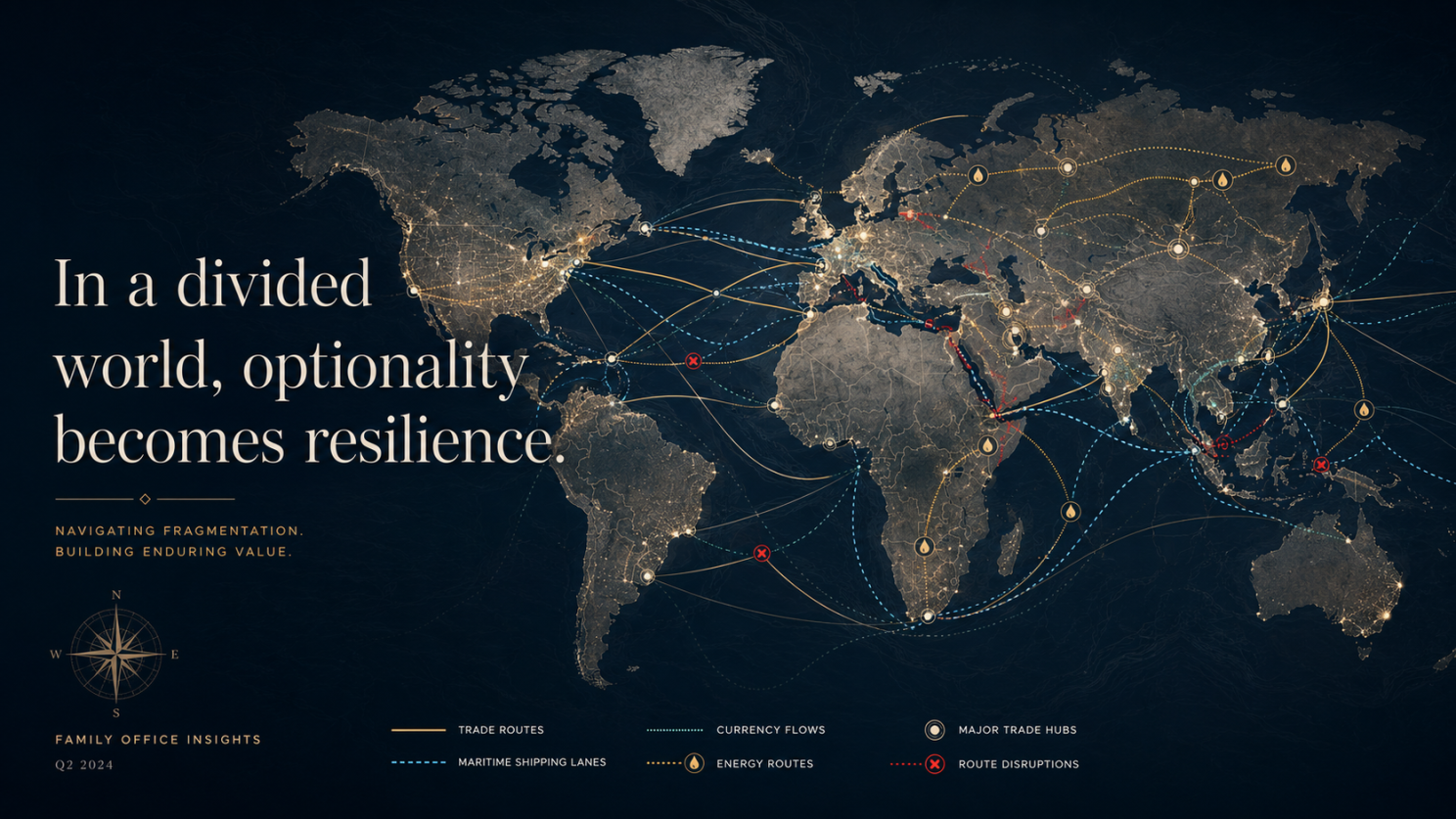
The world is not becoming smaller. It is becoming more divided, more strategic, and more conditional.
For many years, families and businesses operated with a broad assumption that globalisation would continue to deepen. Capital, trade, talent, technology, and ideas were expected to move with increasing ease. That assumption is now being tested.
Trade is being used as a strategic instrument. Technology ecosystems are becoming more divided. Sanctions, currencies, commodities, energy routes, and supply chains are increasingly shaped by political calculation.
For families with businesses, global investments, overseas education plans, NRI or OCI structures, philanthropic commitments, or multi-jurisdictional assets, this matters deeply. The question is not only where assets are held, but how exposed a family is to policy shifts, institutional weakness, currency risk, and geopolitical pressure.
In a divided world, optionality becomes one of the most valuable forms of resilience.
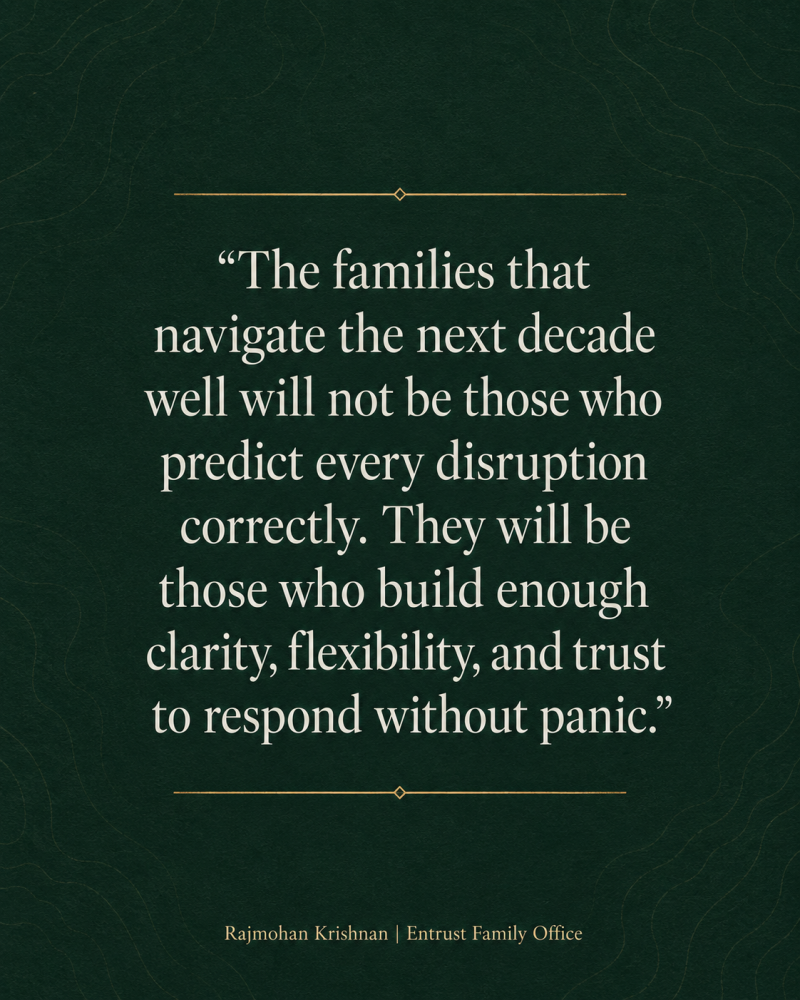
Portfolios may need to be reviewed not only for returns, but for resilience against climate risk, AI disruption, sanctions, currency shifts, and supply-chain volatility.
Operating businesses may face pressure from automation, talent shifts, energy transition, regulation, and changing consumer behaviour. Stronger governance and scenario planning will matter.
The next generation may inherit a world where knowledge expires faster and career certainty is weaker. Preparing heirs will require judgement, adaptability, and exposure to real decision-making.
Climate-linked health risks, medical access, water stress, energy grids, cyberattacks, AI-enabled fraud, and geopolitical instability are changing how families must think about safety, privacy, and continuity.
Every decision begins with a belief. We invest because we believe in an opportunity. We build businesses because we believe something can be done better. We prepare the next generation because we believe a legacy can evolve and endure. Those beliefs influence what we do. Our actions then change the circumstances in which we and […]
For a child who cannot hear, the challenge can extend far beyond hearing itself. It can affect how a child communicates, learns, participates in school and connects with the people around them. When support comes late, these challenges can shape a child’s opportunities well into adulthood. But early identification, the right support and an involved […]
The RBI’s 25 bps hike to 5.50% and its move from “neutral” to “calibrated tightening” came as a supply shock from West Asia pushed major central banks in the same direction. Within about a week in September, the ECB, the Fed and the Bank of Japan all raised rates while the Bank of England held […]
signup for updates